
Interactive Tools for Smarter UX: How Calculators Improve the User Journey
Scroll through almost any modern website and you’ll notice the shift – fewer long paragraphs, more things to touch. Sliders, configurators, quizzes, calculators – all designed to give users something to do, not just something to read. This shift isn’t aesthetic. It’s psychological.
Users want to test ideas, not theories. They come to a site with questions – How much would this cost?, Will it fit my needs?, What result can I expect? – and the faster they get those answers, the more they trust the brand. Interactive calculators do exactly that: they remove guesswork from the user journey.
The Hidden Power of Interaction
When a visitor interacts with your site, they stop being a spectator. A simple action – entering numbers, adjusting a slider, or pressing “Calculate” – changes how they perceive your product. Suddenly, they’re part of the process.
This small act of agency creates an emotional response: ownership. Users feel they’ve contributed to the outcome, which makes them more receptive to what comes next – whether it’s reading further, subscribing or making a purchase. That’s why interactive elements consistently outperform static ones in conversion testing. A calculator doesn’t sell; it shows.
How Calculators Shape the User Journey
Think of a well-designed calculator as a conversation in disguise. Each step – data entry, adjustment and result – mirrors the stages of a sales dialogue:
- The question phase (“What do you need?”) happens when users input data.
- The exploration phase (“Here’s what that looks like for you.”) appears in dynamic results.
- The decision phase (“Here’s your total – let’s go.”) is your call-to-action.
That’s why calculators naturally fit into UX architecture. They guide users from curiosity to clarity – without any friction or persuasion fatigue.
Real Results from Smarter UX
According to UX research, interactive elements increase session duration by up to 70% and reduce bounce rates by over 40%. More importantly, they improve comprehension. When users engage with a process, they remember it. It’s the same principle behind gamification: participation builds retention.
For service providers, this means a pricing calculator can prequalify leads automatically. For SaaS products, it can demonstrate value instantly. For creative agencies, it’s a trust signal – showing transparency through interactivity.
The Tools That Make It Possible
Adding a calculator no longer means custom code. Modern builders let you design, style, and publish one in minutes. Below are three of the most effective tools for creating UX-friendly calculators – each with its own focus.
uCalc: Designed for Instant Engagement

uCalc is built for teams that want interaction – now. Its interface feels like a design workspace rather than a tech tool: drag, drop, customize, publish.
You can build everything from pricing forms to multi-step booking flows without writing a single line of code. Sliders, formulas, dropdowns – all styled to fit your brand’s identity in minutes.
Why UX Designers Love It
- Seamless Integration. Embed your calculator anywhere – Wix, WordPress, Webflow, or plain HTML – with one short code snippet.
- Connected Workflow. Link results directly to email services, CRMs and analytics for smooth lead tracking and data capture.
- Built-in Conversion Power. Add Stripe or PayPal payments to let users pay instantly after calculation – perfect for instant quotes and service bookings.
uCalc keeps the experience smooth, responsive, and visually aligned with your website’s design language – so it feels native, not added.
Best for: Designers, marketers, and small studios who want a professional, conversion-ready calculator without touching code.
CALCONIC - Where Design Meets Logic
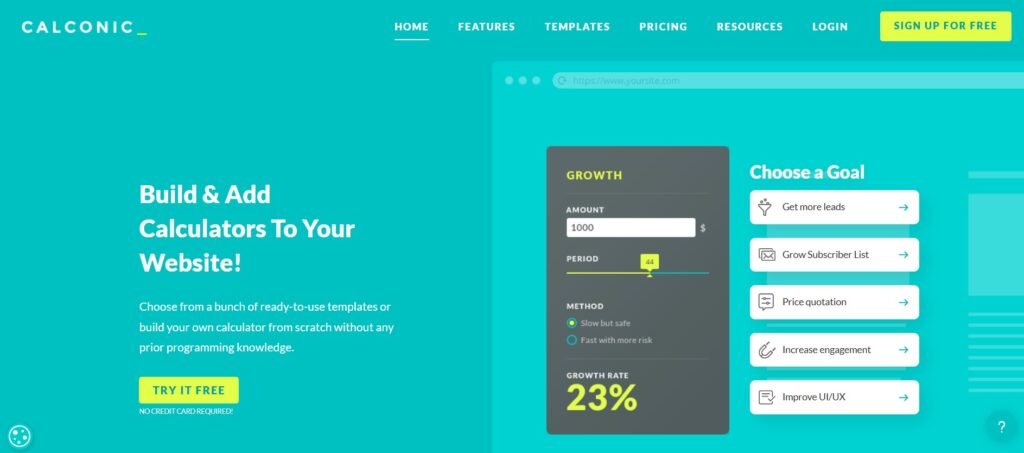
CALCONIC brings a designer’s eye to calculator building. Every layout feels native to your site – same colors, spacing and typography – ensuring flawless brand continuity.
You can customize borders, fonts, shadows, gradients, and transitions, giving complete creative control over every visual detail.
Why Creators Choose It
- Pixel-Perfect Design. Your calculator blends seamlessly with your website’s layout – no mismatched widgets or clunky embeds.
- Smart Functionality. Supports advanced math formulas, multi-step logic and conditional visibility, allowing smooth, guided user journeys.
- Visual Storytelling. Perfect for pricing estimators, donation trackers, and product configurators that look as good as they perform.
CALCONIC turns numbers into experiences, combining precision with elegance.
Best for: Creative agencies and brands that value design harmony and aesthetic consistency above all.
Calculoid - For Data-Driven Interactions
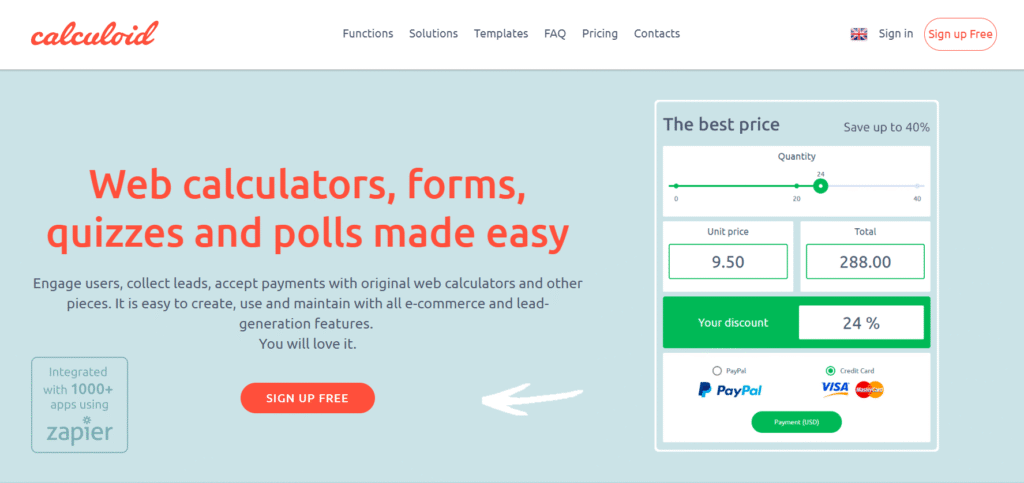
Calculoid is the technical powerhouse among calculator builders. It’s made for SaaS teams, enterprises and financial platforms that need logic-heavy, data-connected workflows.
With complex formula support, API connectivity and real-time data synchronization, Calculoid bridges the gap between user input and business intelligence.
Why Data Teams Prefer It
- Enterprise-Level Integrations. Connect calculators with Google Sheets, HubSpot or Zapier to automate data collection and reporting.
- Dynamic Logic. Create calculators that react to user input in real time – ideal for ROI forecasting, subscription modeling, or loan estimation.
- Scalable Performance. Use advanced user management, branded templates and secure storage for large-scale operations.
Calculoid is less about design finesse and more about computational depth – perfect for analytical, data-first UX.
Best for: Businesses and SaaS products that need accuracy, automation and powerful data integration.
The Future of UX Is Responsive – Literally
Static content used to inform. Interactive content transforms. Every time a user calculates, clicks, or adjusts something on your site, they’re creating a personalized micro-experience – and that’s what modern UX is built on.
Whether you need elegance (CALCONIC), precision (Calculoid) or fast integration (uCalc), the key is to start somewhere. Because in 2026, users won’t just visit your site – they’ll use it.
Our mini-ranking is based on a more extensive study of the 10 best calculator builders published on SuperbWebsiteBuilders.com